ASTORIA’S
LIBERTY THEATRE
by Jackie Meredith
LOCATION
Located
in the heart of downtown Astoria on the corners of 12th and
Commercial Streets, the theatre stands as an icon of dedicated preservation for
historic treasures of the past as well as the visions of dreams-come-true.
MAIN CHARACTERS
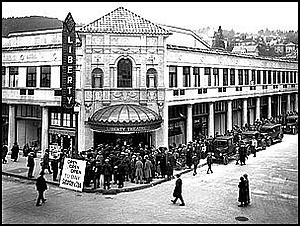 During the 30’s, Astoria originally had
three theatres (the Riviera, the Viking, and the Liberty). Both the Riviera and
Viking struggled and were eventually purchased by Liberty interests. The Liberty
became a part of a chain run by Claude S. Jensen & John Von Herberg. Early
newspaper accounts note that Astoria “was lucky to have such
successful/experienced developers build a theatre in the town.” The team of
Jensen and Von Herberg was responsible for many of the finest theatre operations
in the Northwest, including the extremely successful Liberty Theatre and Neptune
Theatre in Seattle, Liberty Theatre in Portland, and the Olympic Theatre in
Olympia. They were big proponents of the theatre organ as a way to promote business, and quite
enthusiastic about Wurlitzer organs.
During the 30’s, Astoria originally had
three theatres (the Riviera, the Viking, and the Liberty). Both the Riviera and
Viking struggled and were eventually purchased by Liberty interests. The Liberty
became a part of a chain run by Claude S. Jensen & John Von Herberg. Early
newspaper accounts note that Astoria “was lucky to have such
successful/experienced developers build a theatre in the town.” The team of
Jensen and Von Herberg was responsible for many of the finest theatre operations
in the Northwest, including the extremely successful Liberty Theatre and Neptune
Theatre in Seattle, Liberty Theatre in Portland, and the Olympic Theatre in
Olympia. They were big proponents of the theatre organ as a way to promote business, and quite
enthusiastic about Wurlitzer organs.
The
theatre was designed by Portland architects Bennes & Herzog who designed a
number of theatres in the Northwest.
THE DREAM UNFOLDS INTO
REALITY
Originally,
there were two locations for the Astoria Theatre. The first, a 500-seat
theatre at 11th and Exchange Streets, was lost in Astoria’s great
fire of 1922 (the fire devastated more than 30 blocks of downtown). To increase
public morale through social and economic development, reconstruction of public
buildings became a priority. In 1924,
investors purchased land at 12th and Commercial streets (originally
the site of the Weinhart Astoria Hotel). Their goal constituted construction of
a theatre large enough to seat 1000 people, as well as provide space for several
stores, offices, and restaurants.
The
overall theme was what they called Romanesque, with light Italianate. There were
other elements, such as the Hacienda style, tiled roof, Greek columns, and a
Chinese paper and silk chandelier in the auditorium. The interior also features
architectural fabrics of ornamental plaster, which is still intact, as well as
elegant lighting fixtures. The principal interior designs were a series of
Venetian-inspired paintings created by eclectic artist Joseph Knowles,
prize-winner of a competition to provide master painting plans. Since Knowles
had never been to Venice, this turned to be a very challenging task. Within six
weeks, he presented 12 large canvases detailing Venetian waterways. Many of the
local sailors recognized some of the views as the Columbia River with gondolas
instead of their fishing boats.
The
new Liberty Theatre became the gem of Astoria’s entertainment scene. At first
patrons watched silent movies and vaudeville performers. They continued to come
after movies became talkies, and vaudeville faded away. They packed the theatre
in World War II to watch newsreels, and buy War Bonds sold by people like Jack
Dempsey. In addition to movies and the businesses on the first floor, most of
the boys and girls in Astoria learned to dance at a second floor studio.
By the 50’s, the building’s age called
for changes. The original glass canopy was removed and replaced with a modern
marquee with changeable letters. New projectors and a larger screen were
installed.
In 1985, the theatre was listed on the
National Register of Historic Places.
In the early 90’s, the building
desperately repairs, whereupon a group of civic leaders began to explore options
for restoration.
LIBERTY THEATRE TODAY
Liberty Restoration,
Inc., a private non-profit organization, purchased the theater in December 2000.
LRI has raised about half of the $7.5 million cost of the restoration, including
a $1.3 million City of Astoria urban renewal grant and a $399,000 federal Save
America’s Treasures grant.
Restoration of the
Chinese lantern-style chandelier made of paper and cotton, alone cost over
$100,000.
The plan to restore the
historic elegance of the theater, while equipping it to be a contemporary
performing arts center, included a new electrical transformer and distribution
network, new house lighting, repair and painting of the ceiling, and restoration
of the Spanish tile roofing. The Knowles paintings also received a cleaning. New
restrooms and seismic upgrades were also incorporated. A new glass canopy that
closely resembles the original and a reproduction of the original vertical sign
were installed. Retail businesses have also returned to the ground-level spaces.
The theatre celebrated
its Grand Reopening in 2005.
Tours are available by
appointment, and the theater is also open during events and open houses.
FOR MORE INFORMATION
Liberty Theater
Steve Forrester
President, Liberty Restoration, Inc.
Phone: 503-325-3211
E-mail: sforrester@dailyastorian.com
Website: www.liberty-theater.org
REFERENCE
LISTINGS
Haunted
Astoria by Jefferson Davis
<http://www.pstos.org/instruments/or/Astoria/Astoria.htm>
<http://www.hgtv.com/hgtv/remodeling/article/0,,HGTV_3659_1718483,00.html>
<http://findarticles.com/p/articles/mi_qn4184/is_20041129/ai_n10047456>
John Goodenberger, historian
< http://www.pstos.org/history/jensen-vonherberg.htm>
DRIVING
DIRECTIONS
Heading
either west or east on Highway 30, proceed towards downtown. The theatre is
located on the corner of 12th and Commercial Streets at 1203
Commercial Street. (Commercial in the downtown area is a one-way street heading
east.)